


秀光コース生徒が「IIBC高校生英語エッセイコンテスト」で個人部門 最優秀賞と日米協会会長賞に
つながる心、広がる世界がテーマの
英語エッセイが最優秀賞に!
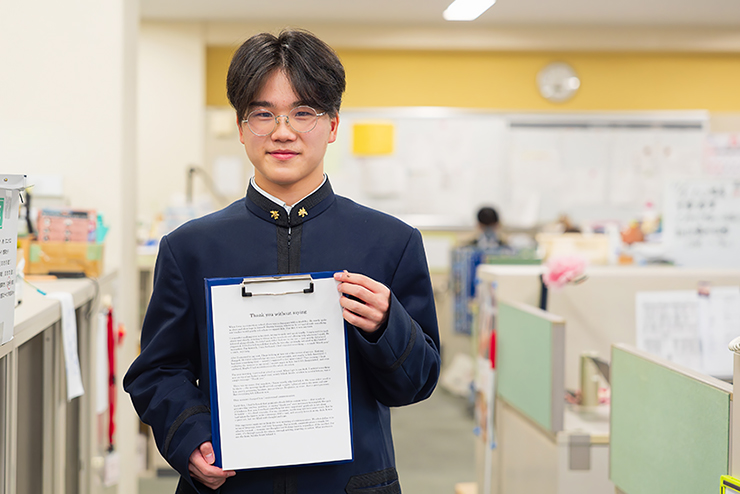
仙台育英学園高等学校 秀光コース1年の圡屋遼人さんが、「第17回 IIBC高校生英語エッセイコンテスト」において、個人部門 最優秀賞と日米協会会長賞の二つの賞を同時に受賞しました。
本コンテストは、高校生が英語で自身の体験や考えを論理的にまとめる力を育むことを目的とした全国規模のエッセイコンテストです。毎年テーマが設けられており、今年度は「つながる心、広がる世界~コミュニケーションを通じた響きあい~」。個人部門では500~700語の英文エッセイが募集され、多くの高校生が参加しました(詳細はこちら)。
圡屋さんのエッセイ “Thank you without saying” は、身近な経験をもとに「言葉にしない感謝」が生み出すつながりを描いた作品で、読後に静かな余韻を残す点が高く評価されました。
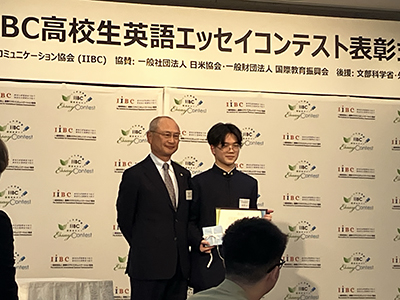
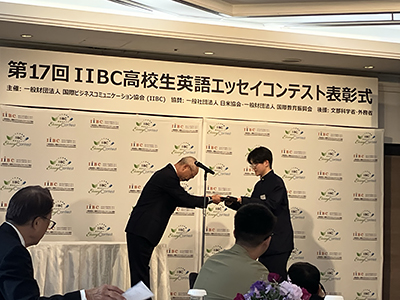
- ▲表彰式の様子
圡屋さんからのメッセージ
自分の伝えたい気持ちが
きちんと届いたことが嬉しい
まず、最優秀賞と聞いたときは、本当に驚きました。まさか自分が選ばれるとは思っていなかったので、“本当かな?”という気持ちでいっぱいでした。エッセイでは、ただ感情を並べるのではなく、その感情がどれくらいのものなのか、どんな揺れ方をしたのかを英語で表すことにすごく悩みました。まず日本語で細かく感情を分けてから、それを英語に置き換えていく作業をしました。ほかにも、国語の授業で学んだ“余韻の残し方”や、秀光中学校から秀光コースの内部進学選考を受けるときに取り組んだ作文の経験も、とても役に立ちました。文章の細かい表現力は、そのとき身についたものだと思います。今回の受賞は、英語力というより、自分が伝えたいと思った気持ちが読んだ方に届いたことが一番嬉しいと感じました。これを励みに、高校2年生から始まる国際バカロレアのDPに向けて、さらに努力をしていきたいと思っています。
『Thank you without saying』全文
When I was in elementary school, there was a classmate with a disability. He rarely spoke in class and often kept to himself. During lessons, whenever he struggled with something, our teacher would gently ask others to support him. One day, it was my turn.
I remember walking over to his desk, trying to smile and speak kindly. I explained the task slowly and clearly, pointing to things in his notebook and offering help wherever I could. He followed along silently. He didn’t nod, didn’t look me in the eye — just quietly did what I suggested. I tried to tell myself that maybe he was shy, or simply not used to this kind of interaction. But honestly, I was bothered. I had expected something — a small “thank you,” a smile, anything.
After I returned to my seat, I kept looking at him out of the corner of my eye. Nothing changed. He didn’t acknowledge me once. I felt invisible, and maybe a little frustrated. I had done something kind — wasn’t I supposed to feel appreciated? That evening, I kept replaying the moment in my mind. I wasn’t angry at him, but I felt disappointed, and even confused. Maybe I had misunderstood the whole situation.
The next morning, I arrived at school as usual. When I got to my desk, I noticed something new on top of my books: a small card, neatly folded. Inside, written in careful letters, was a simple message: “Thank you.”
There was no name. But somehow, I knew exactly who had left it. His name didn’t need to be there — the message itself carried enough weight. I glanced across the room and saw him quietly preparing for class, just as always. No glance, no wave. Just a quiet presence. But everything felt different now.
That moment changed how I understood communication.
Until then, I had believed that gratitude should follow certain rules — that words or gestures like smiling, nodding, or saying “thank you” were necessary to complete the cycle of kindness. But now, I realized something far more important: gratitude is not about formality — it’s about sincerity. For my classmate, words may not have come easily. But he had taken the time to write a message, fold a card, and secretly leave it on my desk. It was a quiet act, but one filled with thought and care.
This experience made me rethink the very meaning of communication. We often define it in terms of language, tone, and body language. But in truth, communication is simply the effort to connect — to make our thoughts and feelings known, regardless of the method. For some, it’s through speech; for others, through writing, drawing, or action. What matters is not the form, but the heart behind it.
Since then, I’ve become more attentive to the silent ways people express themselves — the friend who sits beside you without saying a word when you’re feeling down, the stranger who holds the door a little longer than usual, the sibling who leaves your favorite snack on the table without a note. None of these things is spoken, but they are all forms of communication — and in many ways, they speak louder than words.
Looking back, I’m grateful that I was “bothered” by the silence. If I hadn’t felt that discomfort, I might never have noticed the beauty in that quiet gesture the next day. Sometimes, a gap or a silence is not a lack of connection — it is an invitation to listen more carefully.
The world is full of unspoken messages. We just have to be open enough — and quiet enough — to hear them.
Today, I believe that the most powerful connections are built not only through eloquent words or grand gestures, but through small, heartfelt acts that often go unnoticed. A folded piece of paper. A handwritten note. A silent “thank you.” These are the things that truly connect us.